
Breast Surgery Sydney · Breast Mastopexy
Breast Lift Sydney
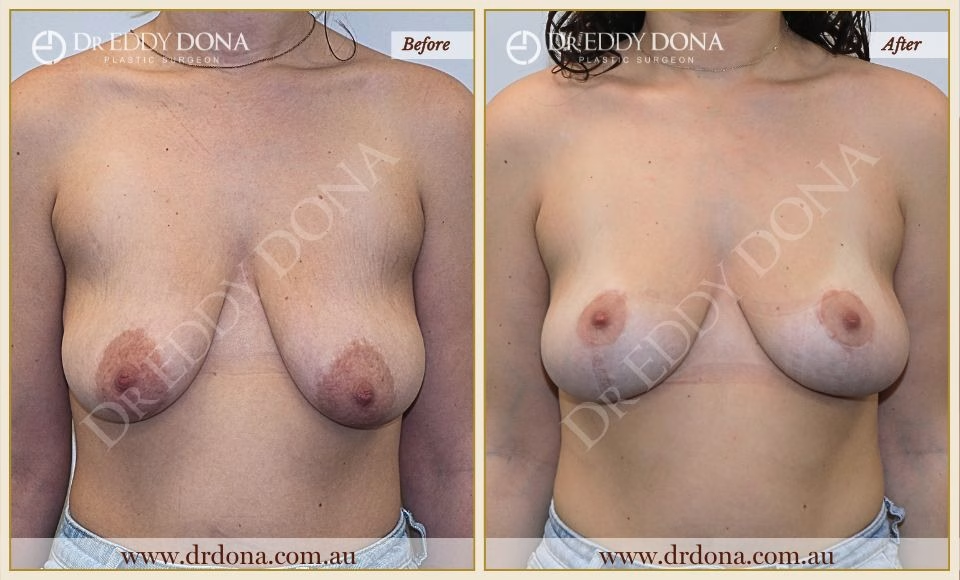
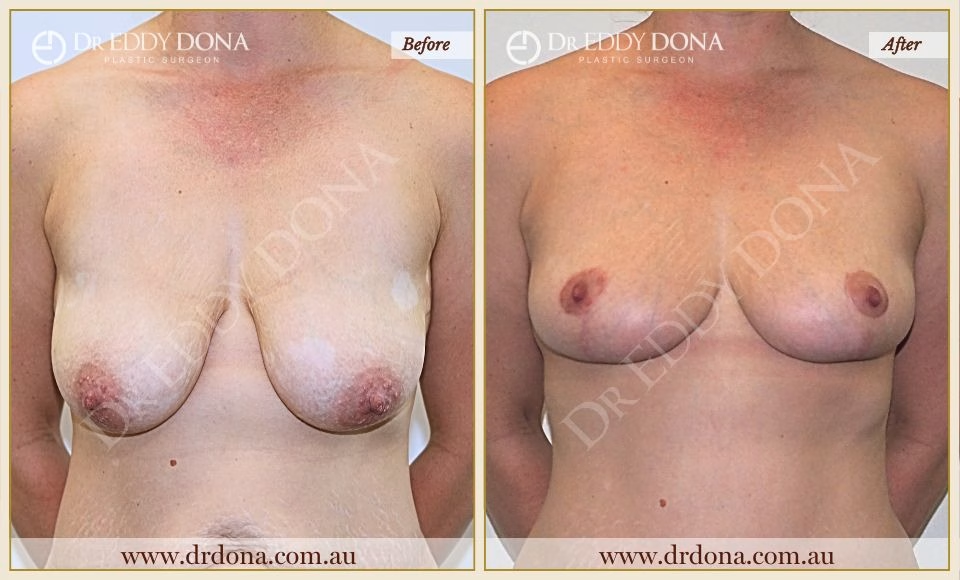
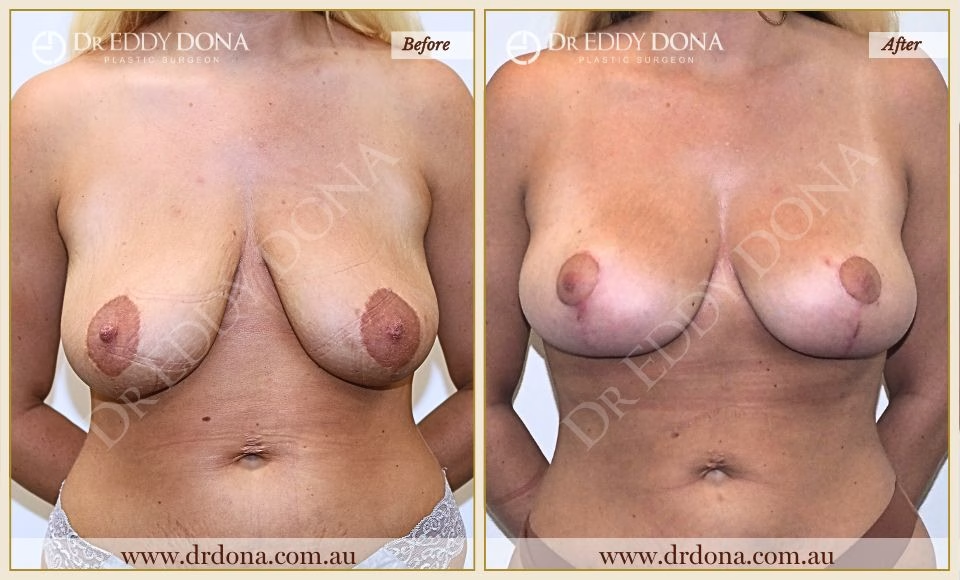
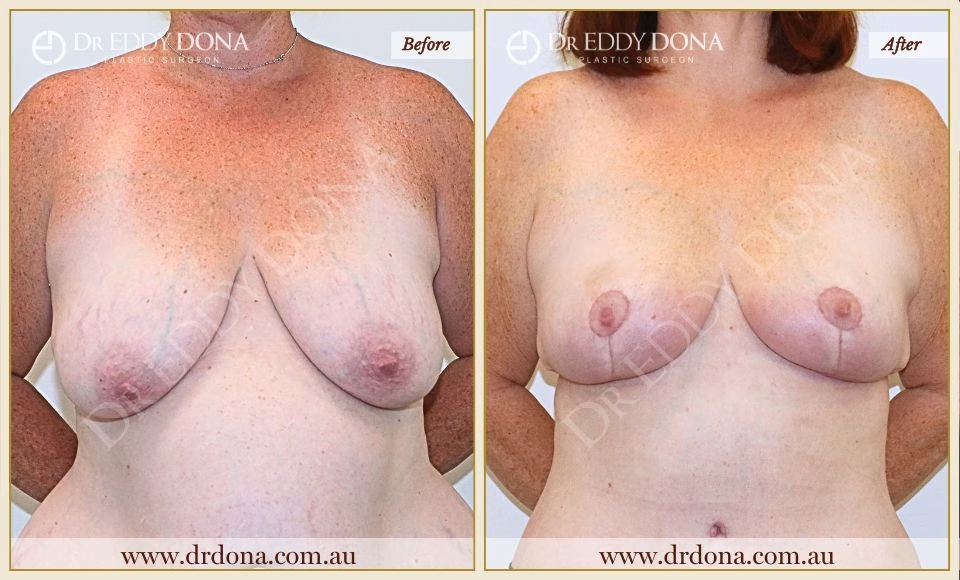
A Breast Lift (Mastopexy) is a surgical procedure designed to address breast drooping or sagging (ptosis). Breast Lift surgery aims to reshape and elevate the breast by repositioning the nipple, removing excess skin and tightening loose tissue in the lower breast.
Unlike a Breast Augmentation (using implants), a Breast Lift does not add volume. However, the procedure can result in a firmer and more elevated appearance.
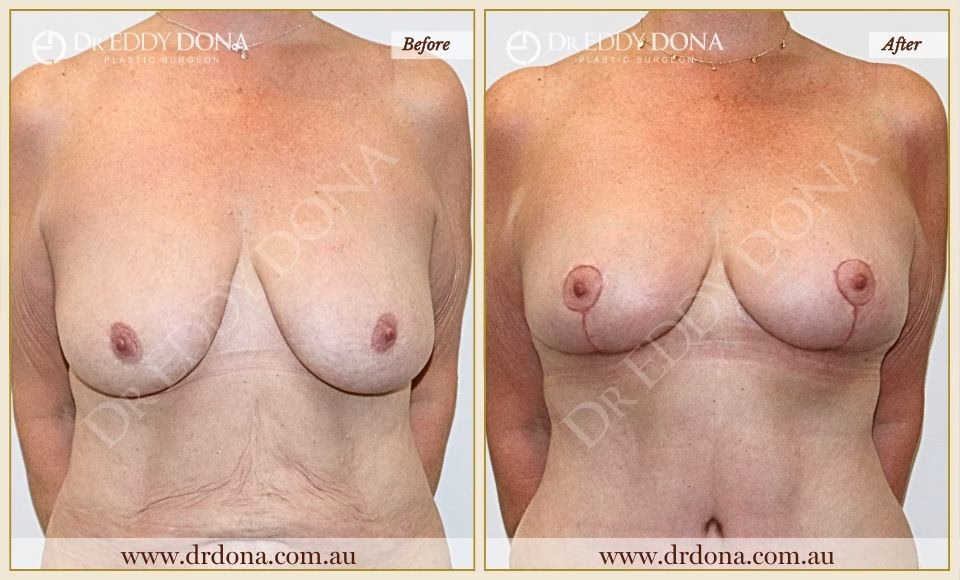
Patient results
Before & After
The displayed before and after pictures are provided as an educational tool to demonstrate some of the results achievable from plastic surgery. All surgeries on this page are performed by Dr Eddy Dona and are published with the written consent by the patients
View before & after galleryThe surgery
Types of Breast Lift (Mastopexy) Surgical Procedures
There are several techniques used to perform a Breast Lift. However, the technique best suited for the patient is determined by the breast size and shape, the size and position of the areola, the degree of sagging, and the quality of the skin.
During your Initial Consultation, Dr Dona will physically examine your breasts and discuss the most appropriate surgical technique that is best suited to your body and your ideal surgical outcome.
Crescent Lift
This technique involves making a crescent or semicircular incision along the upper half of the areola.
This technique is limited as it provides very little lift and can distort the shape of the areola.
Peri-Areolar Lift (Donut Lift)
This technique involves creating a crescent or semicircular incision around the areola.
While this has a larger incision than the crescent lift, a peri-areolar technique can provide a minimal lift and can be used to resize the areola.
Lollipop Lift
This technique is suitable for moderate breast lifting. It involves a circular incision, similar to the peri-areolar lift, but with an additional vertical incision that extends straight down, creating a lollipop shape.
Anchor Lift
This is the most commonly performed Breast Lift technique and is best suited for most patients.
Similar to the previously mentioned techniques, the anchor technique involves a circular incision around the areola with a vertical incision going down the breast.
An incision is also made along the breast crease. The anchor lift technique can significantly reshape and resize the breast to create an extremely effective Breast Lift.
Breast Lift with Implants
Often extra volume is required as well as a lift of the breast tissue – therefore implants are used.
When performing a Breast Lift with Implants, the basic principle means that the surgeon must use the optimal technique for that patient to ensure that the breast tissue is lifted in such a way that there is a uniform distribution of breast tissue over the implant to create a uniform breast shape.
The ideal candidate for this is someone who has minimal breast tissue. However, there are some technical limitations with the implant size that can be used with such an operation. Furthermore, even in the ideal candidate, approximately 20% of patients may benefit from further surgery to “fine tune” the results. However, you would need to wait a minimum of 6 months to allow the results to settle before contemplating and planning this.
It is important to note that a combined breast lift with implants, otherwise known as mastopexy augmentations, is the most difficult cosmetic breast surgical procedures to perform. Therefore, they should only be performed by specialist plastic surgeons that have an expertise in these cases.
However, many plastic surgeons opt to not perform this operation because of the inherent difficulties in doing it.
Am I A Suitable Candidate for Breast Lif(Mastopexy) Surgery?
If you’re considering breast lift surgery, you should be in good physical and mental health, a non-smoker, not currently pregnant or breastfeeding and willing and able to follow post-procedure instructions to support your recovery process.
You may also need to change or pause certain medications, such as blood-thinning medications, as these can raise the risk of complications.
Additionally, you must be aware of all risks and complications associated with your surgical procedure. During your Initial Consultation, Dr Dona will discuss all aspects of the procedure with you, including all associated potential risks and complications.
Why Is A Breast Lift (Mastopexy) Required?
The primary aim of a Breast Lift is to alter the shape of the breasts without changing the breast volume (size).
Whether the breast develops in a way that the patient is unhappy with, or has changed shape over time, the surgery is designed to make the breasts appear in a way that the patient considers acceptable.
The two key elements of a Breast Lift procedure are:
- Lifting a nipple that is sitting lower than the patient is happy with
- Tightening and lifting the tissues below the nipples that are hanging relatively low and often (depending on the breast volume) sit on the abdominal wall.
Factors Determining the Right Type of Breast Lift (Mastopexy) for You
A Breast Lift (Mastopexy) is a surgical procedure that raises and reshapes the breasts by lifting the breast tissue and repositioning the nipple.
This can be performed on its own or combined with breast implants, depending on the desired result.
To determine the most appropriate Breast Lift surgery for you, there are numerous natural anatomical variables that Dr Dona must assess. Due to an individual’s pre-existing breast state, it’s often not possible to achieve the results that they may hope for. This is when, in painting a clear picture, realistic expectations are required.
Breast issues include:
Skin quality – Is the skin loose with many stretch marks or thick and firm without stretch marks? Often, the skin of someone requesting a Breast Lift has lost much of its elasticity. Thin skin that has lost its elasticity has a much greater risk of sagging again.
Degree of ptosis (sagging) – How far does the nipple need to be lifted? Is it sitting below the level of the breast fold, and by how much? The lower the nipples, the greater the difficulty in lifting and keeping them in place.
Nipple direction – Is the nipple pointing downwards or simply droopy but still pointing forwards?
Distance from the nipple to the lower breast fold – If there is a long distance, surgery could be problematic. However, if there is a very short distance, then this could be an even greater problem.
Nipple areolar size – A very large areolar size can be a potential problem with surgery.
Breast tissue quality – Is it firm or soft? Soft breast tissue is very difficult to handle and is often prone to sagging. Another critical factor to understand is that soft breast tissue will always be soft.
Nothing can be done to make soft breast tissue firm again. Surgery simply redistributes the breast tissue. Even with an implant, the breast will still be soft, and it has a much greater risk of sagging again.
Breast tissue volume – The greater the amount of natural breast tissue, the greater the degree of difficulty with the surgery. Lifting a large volume of breast tissue and aiming to keep it up is difficult and often not possible.
The more natural weight a breast has, the more that gravity is going to affect it. Additionally, the greater the amount of natural breast tissue, the more changes will occur over time.
Breast tissue attachment to the chest wall – The degree to which your breast tissue is detached from the chest wall muscle is another issue that is often difficult to explain.
Sometimes the breast tissue is very mobile with loose attachments to the underlying muscle. Effectively, your breast tissue is sliding around over your chest wall. This makes the breast tissue extremely difficult to handle and, therefore, difficult to lift effectively.
Your goals – How would you like your breasts to appear?
Time – The final variable that is impossible to predict is time. The degree to which your natural breast tissue changes after surgery is based on your genetics and personal circumstances and is impossible to know.
Often, women will achieve an excellent result early after surgery, but within a relatively short period of time, their breasts have continued to sag or change. This can be due to issues such as natural fluctuations in breast tissue volume, weight changes or hormonal changes.
When it comes to Breast Lift surgery, perhaps the hardest thing for a patient to accept is that the very reason they would like a Breast Lift is because they have weakened, soft breast skin and tissue, which has sagged.
After surgery, they still have the same skin and breast tissue, so the likelihood of repeated sagging is high.
No surgery and no surgeon can change the quality and consistency of the breast tissue and skin. All the surgeon can do is try to reposition and shape the breast tissue on that day of surgery.

Consultation
Your Breast Lift (Mastopexy) Consultation With Dr Eddy Dona
Your Initial Consultation is the first step in discovering whether a Breast Lift is right for you. During this appointment, Dr Dona will:
- Discuss your concerns and goals
- Review your medical history and any previous procedures
- Examine your breasts to assess the best options for you
If you are a suitable candidate, Dr Dona will explain the surgical approach, outline the expected recovery and discuss potential risks and complications.
Dr Dona will also take the time to answer your questions, so you feel fully informed before making any decisions.
- Fellow of the Royal Australasian College of Surgeons
- Australian Society of Plastic Surgeons
Recovery
Your recovery, step by step
What to Expect on the Day of Your Procedure
Your Breast Lift procedure is performed in a private hospital under general anaesthesia. Typically, Breast Lift procedures can take between 1.5 and 2 hours.
NB: The day before surgery, the hospital will call and advise you of the time you must arrive at the hospital. They’ll also explain all presurgical requirements, such as when to begin fasting before your surgery.
When you arrive at the hospital, you’ll be required to check in with the reception staff. You’ll then be seen by a hospital staff member who will direct you to the presurgical waiting area. This is where you are officially ‘checked in’ for your surgery.
While you wait to be taken to the operating room, the staff will ensure that you’re made as comfortable as possible. We always try to ensure that we schedule your hospital arrival time as close to the surgery time as possible. However, sometimes you may have to wait a little longer than planned before we can start your surgery.
Before your surgery, you’ll be taken into the theatre anaesthetic bay. This is where Dr Dona will see you, have a final chat about your surgery and remind you of what to expect when you wake up. Dr Dona will also make tentative surgical markings on you at this time.
Your anaesthetist will also talk to you about the anaesthetic and medications you’ll be receiving after surgery to keep you as comfortable as possible.
Breast Lift Recovery
What To Expect Immediately After Breast Lift Surgery
When you wake from surgery, the head of your bed will be elevated to maximise your comfort. You’ll be fitted with a breathable cotton bra.
A waterproof dressing will cover your wounds. This will stay in place for one day following your procedure. It will be removed within your first post-operative in-clinic appointment, which occurs one day after your surgery.
At this time, micropore tape will be used along your incision lines. Your incision will have been stitched using several layers of internal dissolving sutures.
Post-Procedure Wound Care and Recovery
Here’s what you can expect regarding your recovery and wound care:
Wound Care
- Dressings – These will cover your breast incisions. These dressings will be removed in your first post-operative appointment, one day after your surgery.
- Medical micropore tape – This will remain on your incisions for approximately one week after your surgery.
- Stitches – These are dissolvable, so they do not need to be removed. However, on rare occasions, a stitch can get irritated and may require manual removal by one of our nurses.
- Medical-grade topical cream – During your first post-operative visit, you’ll receive medical-grade topical cream to be applied to the surgical site. We do not use silicone strips or any other topical products.
Instead, our medical-grade topical cream provides a natural seal of bees wax (binding ingredient in product), while also sending nutrients deep into the second layer of the skin. This topical cream also helps to accelerate healing and increase the formation of healthy scar tissue.
Recovery & Activities
- Showering: You’ll be allowed to shower with assistance. However, you cannot directly wet your incisions for one week post-surgery.
- Pain and discomfort: You may experience some discomfort, which will be managed with pain medication and our HeaLED light therapy program. In most cases, patients feel comfortable and are off pain medication by about one week post-surgery.
- Bloating and constipation: These are common side effects after surgery, due to your strong pain medications and lack of activity — both of which slow down the bowel. To counteract this, we will give you a medication for constipation called Movical. You’ll start taking Movical either while in hospital (if you are staying overnight) or for day surgery patients, you’ll begin taking Movical at home for a few days post-surgery.
- Discharge medications: All patients are provided with medication upon discharge from the hospital. These medications include pain management medication and antibiotics. Please take them as prescribed.
DO YOU NEED A BREAST LIFT (MASTOPEXY)?
Dr Dona explains 5
Patient case studies 5

Patient education
Dr Dona’s Breast Lift eBook
Dr Dona’s Breast Lift Ebook is an excellent educational resource, including – Patient case studies
Questions
Dr Dona answers your questions
What is the difference between a Breast Lift and a Breast Augmentation?
While both these breast surgeries are commonly performed cosmetic procedures, each serves a distinct purpose. A Breast Lift is designed to correct breast sagging (ptosis) by removing excess skin and tightening the surrounding tissue. The procedure reshapes and elevates the breasts, creating a more lifted appearance. Breast Augmentation (Bilateral Augmentation Mammoplasty) involves placing implants beneath the breast tissue or chest muscle to enhance breast size. The procedure is suitable for individuals who would like to restore or increase breast volume. Many patients opt for a combination of both surgeries: Augmentation–Mastopexy. This gives them fuller, more lifted breasts in a single surgical procedure.
How is a Breast Lift performed?
A Breast Lift is performed in a private hospital under general anaesthesia. During the procedure, the surgeon creates incisions tailored to the specific Breast Lift technique. Then, the excess skin can be removed to reshape and lift the breasts. Unlike a Breast Reduction, minimal to no breast tissue is removed. After the excess skin has been removed and the breast tissue repositioned, the new skin edges are then brought together and secured with dissolvable sutures.
How long until I see the final results of my Breast Lift?
You’ll initially notice swelling and upper fullness in your breasts. Also, the lower half of your breast can appear tight and flat. The fullness in the upper part of your breast will slowly settle, and the lower half of the breast will slowly drop and round out. Most of your swelling will have settled after six weeks; however, the final results take six months.
At the six-month mark, your surgeon will critically review your results. However, it’s important to remember that no surgery stops the ageing process. Therefore, after you’ve achieved your final surgical results, your breasts will continue to change based on the normal processes of ageing, gravity, weight fluctuations, childbirth, breastfeeding, hormonal factors and genetics.
Potential Complications
Every surgical procedure carries potential risks and complications. It’s important to be aware of these before making any decisions about surgery.
When undergoing Breast Lift surgery, certain specific complications can occur, such as:
- Scarring – It is impossible to avoid scarring with any surgery. The scar itself can have an unpredictable healing response and cannot be anticipated. Personal, hereditary and racial factors will influence the type and appearance of the scar. However, all patients of Dr Dona are supported by our HeaLED post-surgery care program. This comprehensive plan helps to optimise many aspects of the healing process, particularly minimising the appearance of scars.
NB: As with all scars, they will initially be red and extremely visible. It takes up to 12 months for the scars to fully mature, at which stage we would hope they are fine pale lines, especially after partaking in our post-surgery care program.
- Asymmetry of breast shape and size – With or without surgery, each breast will always differ slightly. However, sometimes this can be significant enough to warrant further surgery.
- Change in nipple-areolar sensation – Nipple sensation can sometimes increase (to the point of irritation) or decrease (potentially completely numb). If changes do occur, they are typically temporary, and within 12 months, most sensations return to the pre-operative state. However, permanently altered sensation can occur in at least 10% of women.
- Loss of nipple and areola tissue – This is extremely rare. It occurs when the nipple and areola have lost their blood supply. Reconstruction can be performed at a later stage. Smoking, large lifts, large implants, diabetes, and previous surgery are some of the factors that can increase the risk of this occurring.
- Inability to breastfeed – Any surgery that disrupts the breast milk ducts will result in a potentially reduced ability to breastfeed. The more substantial the lift required, the greater the risk that your breastfeeding ability will be reduced.
- Breast lumps – This is likely due to a small collection of blood or dead fat cells that are still healing.
- Breast Ptosis (sagging) – Despite performing a Breast Lift, the breast tissue itself will always tend to drop down. It is therefore not uncommon for the upper part of the breasts to look appealing to the patient, as this is primarily shaped by the implant. However, the lower part of the breasts can often still look droopy, as this is typically shaped mainly by the remaining breast tissue. Having a larger amount of natural breast tissue and breast tissue that is very soft are just some of the factors that make this more likely to occur.
- Upper pole emptiness – A Breast Lift is designed to lift a low-sitting nipple, tighten loose flesh in the lower half of the breast, and provide a better breast shape. As a general rule, it does not provide significant upper pole fullness. This is especially true for women with very soft breast tissue. Upper pole fullness is typically achieved by an implant.
- Inadequate cleavage – This can occur for many reasons, even in a simple Breast Augmentation. However, having a Breast Lift with augmentation means there is an increased likelihood of this happening due to technical limitations when combining the two operations. The most significant concern when doing this surgery is ensuring adequate blood supply is maintained to the nipple and areolar region. Therefore, limiting the amount of internal surgery near the cleavage is one of the surgical steps used to avoid compromising this crucial blood supply. This means that technically, we are unable to maximise your potential cleavage.
- Revision surgery – For those undergoing a Breast Lift with implants, further surgery may be considered in up to 20% of patients to ‘optimise’ their results.
Surgical & non-surgical procedures
Request a consultation
1300 DR DONA (1300 373 662)(02) 8805 7600
Suite 413, 29-31 Lexington Drive, Bella Vista NSW 2153
Monday to Wednesday 9:00am to 4:30pm
Thursday to Friday 9:00am to 6:00pm